Employment Disputes – Strike period safety warning – NZPFU declines request to agree community safety process

Source: Fire and Emergency New Zealand

Fire and Emergency New Zealand is warning the public to take care and be vigilant during today’s strike by the New Zealand Professional Firefighters Union (NZPFU).
The strike will take place between midday and 1pm and will mean responses to emergencies in areas covered by paid firefighters will be delayed.
“We’re reminding the public to be cautious during this period. We will continue to answer calls and respond to fires, but our response times will be longer than normal given volunteers will be responding from the next nearest station,” National Commander Megan Stiffler says.
“This was demonstrated last Friday with the fire in Pakuranga. Following that event, we again reached out to NZPFU officials to ask them to agree a process for responding to emergency events. 
“Our aim was to put arrangements in place to mitigate risk to public safety during strikes, while preserving NZPFU members’ right to take industrial action. 
This would cover potential loss of life when fires are likely to spread and the need for specialist equipment.
“A range of other organisations in New Zealand have specific requirements to mitigate risk to public safety when taking strike action and given the nature of the work we do I believe we have an obligation to work together to develop arrangements during industrial action.
“Unfortunately, our request was rebuffed by the NZPFU so we’re again warning the public to take extra care during today’s strike. 
“We have consistently called on the NZPFU to call off these strikes while we’re actively engaged in independent facilitation to progress collective agreement negotiations. There is no point in putting public safety at risk when that process is ongoing,” Megan Stiffler says. 

Northland News – Marris to head Kaipara Moana Remediation Operations

Source: Northland Regional Council

Kaipara District Council (KDC) chief executive Jason Marris has been appointed the new Pou Tātaki (General Manager) of Kaipara Moana Remediation (KMR) operational arm Kaipara Maurikura.
Kaipara Moana Remediation Joint Committee Chair Tame Te Rangi says Mr Marris offers a profile of more than 25 years of experience in leading, motivating, and developing multi-disciplinary professional teams.
Whangārei-based Mr Marris has been Chief Executive of KDC since November 2022 and has also held management roles at the Whangarei District and Auckland Councils. Prior to his local government career, he spent approximately 12 years with the New Zealand Defence Force.
Tame Te Rangi says Mr Marris will lead a 12-strong team at Kaipara Maurikura, a collaboration to reduce the impact of sediment on the mauri of Kaipara Moana, Aotearoa’s largest harbour system which spans 6000 square kilometres across both Northland and Auckland, including more than 8000km of rivers and streams.
The organisation’s long-term goal is to halve sediment flows into the Kaipara. Across the headwaters of the key river system catchments, KMR invests in projects to restore wetlands, fence off rivers and streams, and plant trees or regenerate forest in the riparian margins and on erosion-prone areas.
Tame Te Rangi says Mr Marris – who will take up his new role in mid-April – is passionate about creating alignment between people, strategy, policy, and operations to deliver impactful work programmes.
“Known as a values-driven leader and a true people person, Jason works effectively across all levels of an organisation and excels at viewing challenges from multiple perspectives.”
Tame Te Rangi thanked KMR’s Acting Pou Tātaki Emma Doré, who has helmed the organisation since former Pou Tātaki Justine Daw resigned from her role in early December. 

Fire Safety – Restricted Fire Season in coastal parts of North Otago

Source: Fire and Emergency New Zealand

Outdoor fires will need a permit in the coastal area of North Otago from Monday morning, when Fire and Emergency New Zealand brings in a Restricted Fire Season for its Coastal Waitaki Zone.
The zone stretches from just south of Palmerston to the Waitaki River and extends about 50km inland.
Inland Otago is already in a Restricted Fire Season, including Queenstown Lakes, Central Otago and northern parts of the Waitaki District.
District Commander Craig Gold says that the latest change in fire season reflects the increasing levels of fire risk around Otago. In spite of intermittent rain, vegetation is drying out rapidly and will burn readily.
Declaring a Restricted Fire Season means that farmers, contractors, forestry contractors and others can still carry out controlled burns on their land if they need to, but they will have a permit which provides clear guidelines and advice on how to use fire safely.
There are exemptions for cultural cooking fires, but other types of recreational fires like campfires and bonfires will also need a permit, obtained in advance.
Go to www.checkitsalright.nz to find out the fire season status for any location in the country, and get advice on how to use fire safely.

Annual food prices increase 4.0 percent – Selected price indexes: December 2025 – Stats NZ news story and information release

Source: Statistics New Zealand

Annual food prices increase 4.0 percent – news story


16 January 2026

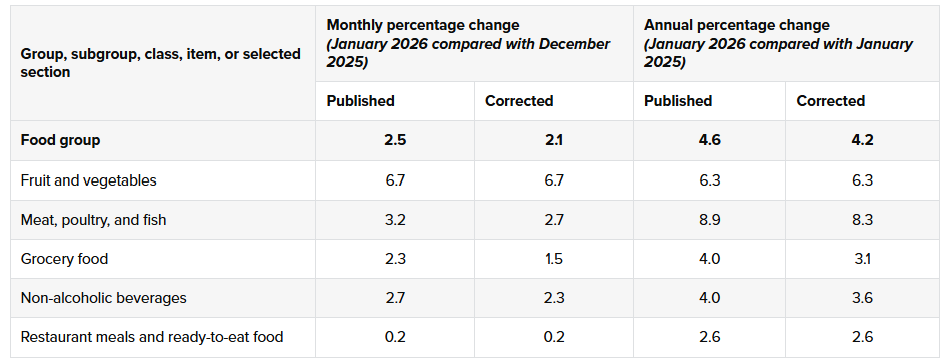
Food prices increased 4.0 percent in the 12 months to December 2025, following a 4.4 percent increase in the 12 months to November 2025, according to figures released by Stats NZ today.

Higher prices for the grocery food group, up 4.6 percent, contributed the most to the annual increase in food prices. This was followed by meat, poultry, and fish, up 7.4 percent annually.

The average price for:

  • milk was $4.92 per 2 litres (previously $4.25), up 15.8 percent annually
  • beef steak – porterhouse was $44.30 per kilogram (previously $36.39), up 21.7 percent annually
  • white bread was $2.20 per 600 grams (previously $1.39), up 58.3 percent annually.

The average prices for milk and bread represent the cheapest available options.

Visit our website to read the full news story and information release and to download CSV files:


Tatauranga umanga Māori – Statistics on Māori businesses: September 2025 quarter – Stats NZ information release

Source: Statistics New Zealand

Tatauranga umanga Māori – Statistics on Māori businesses: September 2025 quarter – information release


15 January 2026

Tatauranga umanga Māori – Statistics on Māori businesses: September 2025 quarter presents information on one subset of Māori businesses that contribute to our country’s economy. This release includes data on Māori authorities and related businesses. It does not cover all Māori businesses in Aotearoa New Zealand.

Māori authorities are defined as businesses that receive, manage, and/or administer assets held in common ownership by iwi and Māori. Māori authorities are largely identified through their tax codes as registered with Inland Revenue. Any business within a Māori authority ownership group is also included for the purposes of Tatauranga umanga Māori.

Key facts
In the September 2025 quarter, around 1,500 Māori authorities and related businesses were in the Tatauranga umanga Māori population.

All figures are actual values and are not adjusted for seasonal effects.

In the September 2025 quarter compared with the September 2024 quarter:

  • the total value of sales by Māori authorities was $1,094 million, down $9.8 million (0.9 percent)
  • the total value of purchases by Māori authorities was $700 million, down $79 million (10 percent)
  • the total number of filled jobs for Māori authorities was 11,680, down 440 jobs (3.6 percent)
  • the total value of earnings by employees of Māori authorities was $231 million, down $2.2 million (1.0 percent)
  • Māori authorities exported $231 million worth of goods, up $7.4 million (3.3 percent).

Visit our website to read the full information release and to download CSV files:


Gaza – 100 days into ceasefire Gaza still deliberately deprived of water as aid groups forced to scavenge under illegal blockade – Oxfam

Source: Oxfam Aotearoa

Oxfam and partners restore limited water access for 156,000 amid near-total water and sanitation infrastructure collapse.
100 days into the ceasefire announcement, in a week that has seen more severe weather hitting Gaza, needs remain desperate. Oxfam and dozens of other INGOs working in Gaza have had to further adapt their operations to keep life-saving work continuing, even as they face uncertainty over new registration requirements imposed by Israeli authorities.
Despite months of severely restricted aid inflows, amidst power disruptions, access shutdowns and repeated rejection of essential materials, work has continued. Oxfam has worked around the clock with experts from local partner organisations, to restore vital water wells – even sifting through rubble to salvage and repurpose damaged materials, including sheet metal.
According to assessments carried out by Oxfam’s partner, the Coastal Municipalities Water Utility (CMWU), the total cost to rebuild all of the water and sanitation facilities, systems and infrastructure which have been destroyed or damaged by Israel in Gaza will be around $800 million. However, the figure could be even higher, since parts of Gaza remain inaccessible and construction costs have also doubled, due to the lack of materials being allowed in.
The wells restored by Oxfam and partners are located in Gaza City and Khan Younis, and are now providing at least 156,000 people with a life-saving and sustainable water supply. Work continues on a further eight wells and two water pumping stations, which should be working again by February, providing continuous fresh water for 175,000 more people.
Wassem Mushtaha, Oxfam Gaza Response lead, said: “We did not just re-open these wells. We have been solving a moving puzzle under the siege and restrictions to make the wells operational – salvaging parts, repurposing equipment, and paying inflated prices to get critical components, all while trying to keep our teams safe.
“For as long as systematic policies and practices preventing aid agencies from getting essential supplies into Gaza persist, we will have to keep finding a way to reach people in need. It’s not an acceptable situation, but as humanitarians, we can never give up trying to save lives.
“So much more could have been achieved if our efforts had not been undermined at every turn – which continues to this day. Oxfam alone has over 2 million dollars’ worth of aid and water and sanitation equipment ready to enter Gaza, but these supplies have been repeatedly rejected since March 2025.”
Israeli authorities have made a meaningful humanitarian response impossible by design. Israel defends threats to deregister up to 37 international NGOs – claiming humanitarian organisations’ impacts have been “inconsequential.” But NGOs have repeatedly appealed to Israel to be allowed to do their jobs, calling on Israel to lift restrictions undermining civilian survival. In reality, Israel continues to block effective relief efforts and the restoration of essential infrastructure.
In response to the challenges, Oxfam has increased its procurement of aid from local markets where possible, and continues to expand services in areas such as social-psychological support and health promotion, WASH, emergency livelihoods, multi-purpose cash transfer, food voucher distribution, and public health promotion – essential areas, with less reliance on materials that Israel continues to systematically reject.
Monther Shoblaq, Director General of CMWU, said aid agencies should not have to operate in a way that is needlessly time consuming and exhausting:
“While it’s commendable that dedicated staff are going to such lengths to bring water access to those who need it so desperately, the equipment needed is just across the border, blocked from entry. Agencies are having to resort to salvaging materials from the rubble of bombed water infrastructure and the remains of people’s homes, repurposing parts, and paying inflated prices. This is the direct result of Israeli restrictions, last-resort measures forced by siege conditions.
Needs in Gaza exceed far beyond the aid and reconstruction materials Israel is allowing in and the situation will worsen if Israel’s collective punishment and illegal blockade continues. Water deprivation is just one of the many human rights violations Israel has undertaken with impunity. Oxfam and other organisations who have operated in Gaza for decades must be allowed to respond at the scale.
Notes
Since the Gaza ceasefire was announced, 100 days ago, on 8 October, Israel's military attacks continue. Over 440 Palestinians in Gaza have been killed. Over 2,500 residential buildings have been destroyed, leaving people forced into displacement. Severe restrictions on aid inflows persist.
Despite all the access and security challenges, Oxfam has reached over 1.3 million people in Gaza with aid since the beginning of the escalation in conflict in October 2023.
According to the UN , 1.1 million Palestinian in Gaza are in urgent need of assistance in the harsh winter conditions.
In a recent survey conducted by Oxfam, examining households in Khan Younis and Gaza Governorates, it has found:
  • 87 per cent of people lacked access to basic essential services
  • 89 per cent were dependent on unsustainable water trucking to get just the bare minimum level of water needed to survive
  • 66 per cent of latrines used by those surveyed were partially functioning or in need of repair, meaning many were resorting to open defecation, risking the spread of disease
  • 84 per cent of households reported outbreaks of disease in the last few weeks
  • 77 per cent of households had no income whatsoever
A recent report – Preliminary Environmental Damage Assessment Report of the Israeli War on the Gaza Strip, 2023-2025, published by the Palestinian Environment Quality Authority (EQA), reported: ( -Report in Arabic, translation available on request)
Catastrophic Infrastructure Collapse
  • 80%+ of water facilities destroyed – networks, pumping stations, main lines, tanks, wells
  • 700,000 linear meters of water networks destroyed (main and branch lines)
  • 134 of 214 water projects destroyed completely or partially
  • Only 84 facilities operating at 15.5 m³/day capacity
  • Production collapsed 84% – only 21,200 m³/day vs. 255,000 m³/day pre-war
  • Water per capita: As low as 3 liters/day in northern Gaza (vs. WHO emergency minimum of 15 liters/day)
Wells & Infrastructure
  • 162 of 284 wells destroyed completely or partially (93 severely damaged)
  • 9 water tanks of various sizes destroyed
  • 70% of Israeli supply lines to Gaza destroyed
  • Of the 3 desalination plants, only one is fully operational, with one totally destroyed, and one only partially operational
  • Current desalination: 18,500 m³/day (only 55% of pre-war capacity of 33,000 m³/day)
Groundwater Contamination
  • -97% of groundwater already non-potable pre-war
  • Chloride levels: 1,000 mg/L (WHO limit: 250 mg/L)
  • Nitrate levels: Up to 400 mg/L (WHO limit: 50 mg/L)
  • Water table: Dropped to -19 meters below sea level
  • 120,000 m³/day of untreated sewage discharged into sea and land
Sewage Catastrophe
  • All 6 wastewater treatment plants: Out of service (total capacity: 52 million m³/year)
  • 120,000 m³/day of raw sewage discharged to sea and land
  • Sewage network destruction causing groundwater contamination
  • Beach water: High levels of intestinal parasites (Ascaris, Entamoeba, Giardia
Long term environmental impact
  • Groundwater: Already 97% non-potable – will take generations to recover
In recent days OCHA has reported
  • Heavy rains have damaged and overwhelmed water infrastructure in the Gaza Strip. To keep de-watering pumps operational, the humanitarian community is engaging with Israeli authorities to allow entry of specialized equipment.
  • Flooding is often compounded by sewage overflow from damaged systems. Yet basic equipment like water pumps, sandbags, and construction materials such as timber and plywood needed to reinforce shelters and drainage are delayed or rejected under “dual-use” restrictions and bureaucratic clearance processes.
  • 40% of the population are living in flood-prone areas
Gaza Humanitarian Situation Report published Jan 9 stated:
  • Between 5 and 8 January, 36 WASH Cluster partners trucked 21,530 cubic metres (m3) of drinking water and 10,453 m3 of domestic water daily to displaced families through 2,350 water points across the Strip. This effort involves collecting water from three seawater desalination plants, up to 64 brackish water desalination plants, more than 100 groundwater wells, and deploying a fleet of 250 water trucks.
  • On 8 January, the Cluster completed the installation of the Beit Lahia Desalination Plant. The plant consists of three units with a total production capacity of 35 m3 per hour and has begun distributing water to various areas across Beit Lahiya, in North Gaza Governorate.
  • Critical challenges include severe limitations on fuel access for WASH services, which affect water production and distribution, solid waste management, stormwater management and repair activities. There is also a shortage of essential humanitarian items such as generators, reverse osmosis systems, and spare parts for pumps, generators and vehicles. Slow approvals for the entry of water reservoirs and pipes are preventing WASH actors from installing safe water collection points, forcing communities to collect water directly from water trucks.
  • Heavy rains have damaged and overwhelmed water infrastructure in the Gaza Strip. To keep de-watering pumps operational, the humanitarian community is engaging with Israeli authorities to allow entry of specialized equipment.
  • Flooding is often compounded by sewage overflow from damaged systems. Yet basic equipment like water pumps, sandbags, and construction materials such as timber and plywood needed to reinforce shelters and drainage are delayed or rejected under “dual-use” restrictions and bureaucratic clearance processes.
  • 40% of the population are living in flood-prone areas.

Children in Gaza killed by cold and collapsing buildings as conditions gnaw away at daily life – Save the Children

Source: Save the Children

Children in Gaza are being killed by collapsing buildings and freezing cold temperatures as tents that are the sole shelter for families are blown away in strong winds, Save the Children said. 
Despite a pause in hostilities four months ago, more than two years of Israeli bombardment, restrictions on aid delivery and a lack of equipment and supplies to rebuild have left life in Gaza barely sustainable. The UN  said this week that at least 100 children have been killed since the latest pause in hostilities began on 10 October. 
Shurouq, Save the Children Multimedia Manager in Gaza, said: 
“Conditions in Gaza are gnawing away at daily life. At least seven children and 24 adults have died this winter from lack of shelter from the freezing cold. Several people including children have been killed or injured from falling remnants of rubble. 
“For most people there is no home to return to. Flimsy tents are not enough to shelter families from the winter, and the state they are in is an insult to the litany of injuries that Palestinians in Gaza have endured over the past two years. 
“We have been working through local partners to distribute tents and other winter supplies. But families are telling us this is not good enough – it is just a sticking plaster over a gaping wound. “Winter clothing is scarce and expensive – we are still seeing children wearing summer clothes, in winter temperatures, rain and strong winds. Soaked mattresses from flooded tents take at least three days to dry when it’s sunny, which isn’t often. 
“We are committed to doing everything humanly possible to save lives and restore basic services, and expect the same determination from humanitarian organisations, governments and the private sector supporting Gaza’s recovery.” 
Save the Children is continuing to deliver lifesaving services and multi-sector programming through our 300 Palestinian staff and trusted local partners in the occupied Palestinian territory (oPt). 
Inside Gaza, the aid organisation runs child-friendly spaces, temporary learning spaces and mental health and psychosocial support for children as well as child protection case management. 
Save the Children is also running health clinics, nutrition points, water and sanitation services and livelihoods programmes to support families whose livelihoods have been decimated. 
While we have been unable to bring supplies into Gaza for some months, we are procuring supplies locally within Gaza to distribute. Save the Children is delivering newborn baby kits, and hygiene kits as well as medical supplies.
About Save the Children NZ:
Save the Children works in 120 countries across the world. The organisation responds to emergencies and works with children and their communities to ensure they survive, learn and are protected.
Save the Children NZ currently supports international programmes in Fiji, Cambodia, Bangladesh, Laos, Nepal, Vanuatu, Solomon Islands and Papua New Guinea. Areas of work include child protection, education and literacy, disaster risk reduction and climate adaptation, and alleviating child poverty.

Weather News – A wet summer week: Heavy rain and thunderstorms – MetService

Source: MetService

Covering period of Thursday 15th – Monday 19th January.

  • Broadscale Heavy Rain Watches and Warnings in place for areas of the North Island and top of the South Island, as well as the potential for localised Severe Thunderstorms and Downpours for much of the North Island 
  • Colder temperatures in the coming days, particularly in the east.

Heavy rain, downpours and thunderstorms are on the cards for the North Island and top of the South Island today (Thursday) and some of tomorrow (Friday) as an active low from the west moves over the country. Things ease somewhat in the following couple of days but  not a full return to settled summer weather we’re hoping for.  

Today sees the most action for the North Island. Bay of Plenty and Rotorua are under an Orange Heavy Rain Warning until 11am Friday, as well as Taranaki Maunga until 11pm tonight (Thursday). Auckland, Waikato, Waitomo, Taumarunui, Tongariro National Park, Kapiti/Horowhenua and Wellington are under Yellow Heavy Rain Watches today (Thursday).  

Severe Thunderstorm Watches are in place for the remainder of the North Island today, with the exception of Gisborne and Northern Hawkes Bay. However, Severe Thunderstorms and downpours are also a risk for the areas with Heavy Rain Watches and Warnings. This means that most areas have the possibility to see Severe Thunderstorm Warnings issued today.

MetService Meteorologist Katie Lyons states, “Many areas in the North Island have broadscale heavy rain today, but on top of that, those areas also have the risk of localised shorter-lived downpours. Both of these can cause flooding, with the downpours often tipping it over the edge.,”

This system will gradually move off to the east tomorrow, but not before giving a risk of thunderstorms for Eastern Bay of Plenty, Gisborne, and Wairarapa.

The South Island also has it's own set of Heavy Rain Watches and Warnings today. Northern Marlborough is under an Orange Heavy Rain Warning until 5pm today, with Yellow Heavy Rain Watches for the Tasman, Nelson, southern Marlborough, and northern Canterbury regions.  

“Rain and showers spread across the remainder of the South Island today and tomorrow, with a multiday stint of overcast and rainy conditions starting for the east coast,” states Lyons.

 
Rain becomes mainly confined to eastern and far north areas over the next couple of days, as our broadscale setup changes to a high pressure system to the west-southwest, and easterly winds set to prevail across the country. While the action dies down over the next couple of days, unfortunately it's not the beautiful, hot, clear-skied summer we are holding out for.
 

After the warmer temperatures we had last week, these coming days will feel much chillier, particularly around our east coasts. Maximums for Napier and Gisborne will struggle to reach 20°C from Saturday, with Canterbury maximums sitting around 15°C.

“Peering ahead for Wellington Anniversary Day, Kapiti and Horowhenua up through Whanganui look to be sunnier than Wellington itself, so a road trip and beach day may be on the cards for Monday,” says Lyons.

It’s been a quiet tropical cyclone season in the South Pacific but there’s an area of interest northwest of New Caledonia which sees increased risk of development over the weekend. This may see a tropical cyclone form early next week. We’ll be keeping an eye on developments and put out messaging if there’s significant risk of impact to New Zealand.  

National accounts (income, saving, assets, and liabilities): September 2025 quarter – Stats NZ information release

Source: Statistics New Zealand

National accounts (income, saving, assets, and liabilities): September 2025 quarter – information release


15 January 2026

We have developed experimental quarterly estimates for institutional sector accounts and balance sheets, to provide more timely data on New Zealand’s economy. We have published these experimental estimates on a quarterly basis since the first release for the March 2021 quarter.

Key facts

Quarterly income and outlay accounts
In the September 2025 quarter, compared with the June 2025 quarter (in seasonally adjusted terms):

  • household saving decreased $928 million to $703 million
  • household net disposable income fell 0.7 percent ($471 million):
    • income tax payable rose 3 percent ($468 million)
    • interest received by households fell 5.9 percent ($198 million)
    • income of self-employed businesses (entrepreneurial income) received by households rose 0.9 percent ($101 million)
    • compensation of employees rose 0.1 percent ($69 million)
    • dividends received by households fell 2.2 percent ($36 million)
    • interest paid by households fell 6.1 percent ($159 million)
  • household final consumption expenditure rose 0.7 percent ($457 million)
  • non-financial business enterprises saving rose $2.9 billion to $6.2 billion
  • interest received by financial business enterprises fell 6.0 percent ($688 million)
  • interest paid by financial business enterprises fell 5.1 percent ($578 million).

Visit our website to read the full information release and to download CSV files: