
Statement by UNICEF Executive Director Catherine Russell on the children killed by the alarming escalation of violence in the Middle East

Source: UNICEF

NEW YORK, 15 June 2025 – “This weekend’s surge in violence across the Middle East signals a dangerous escalation. Children are once again paying the ultimate price.

“Since Friday, an intense military escalation in the region has seen strikes on Iran and Israel hit residential areas, killing and injuring civilians – including children – and causing damage to civilian infrastructure.

“Beyond the death toll, this alarming escalation creates widespread fear and trauma among children in all communities.

“UNICEF strongly condemns all forms of violence against children. Our thoughts are with all the families and communities mourning this tragic loss of life.

“We reiterate the Secretary-General's call for all sides to show maximum restraint, avoiding at all costs a descent into deeper conflict, a situation the region and its children cannot afford.

“UNICEF urgently calls on all parties to uphold their obligations under international law and to ensure the protection of civilians, in particular children. All children have the right to live without the threat of war and violence.

“UNICEF, together with other UN agencies and humanitarian partners, is actively assessing the situation and remains ready to scale up support to affected children and their families as needed and requested.”

About UNICEF

UNICEF, the United Nations agency for children, works to protect the rights of every child, everywhere, especially the most disadvantaged children and in the toughest places to reach. Across more than 190 countries and territories, we do whatever it takes to help children survive, thrive, and fulfil their potential. 
For more information about UNICEF and its work, please visit: www.unicef.org
Legislation – Māori marginalised by changes to Pae Ora Act – PSA

Source: PSA

The Government’s Cabinet-approved amendments to the Pae Ora (Healthy Futures) Act represent yet another attack on Māori aspirations for equitable health outcomes and self-determination the PSA says.
The sweeping changes announced by Minister of Health Simeon Brown on 14 Pipiri (June) 2025 are regressive and undermine the intent and spirit of Te Tiriti o Waitangi and the hard-fought recognition of Māori leadership in health delivery, Te Pūkenga Here Tikanga Mahi – the Public Service Association Kaihautū Māori, Janice Panoho, says.
“The Pae Ora Act was a step towards correcting decades of inequity and systemic failure in health. These amendments strip away the very mechanisms Māori advocated for and were promised, particularly the ability to shape local service design and delivery through Iwi-Māori Partnership Boards IMPBs),” says Panoho.
“This is a heartless government, pushing through draconian policy under the guise of efficiency. What they call ‘streamlining’ is in fact the deliberate sidelining of Māori voices from decisions about Māori health.
“Rather than enhancing Te Tiriti partnerships, the changes weaken Māori influence by making iwi-Māori Partnership Boards (IMPBS) mere advisors to the Hauora Māori Advisory Committee, removing their direct role in shaping services that affect their own communities.
“This top-down, centralised approach reverts us to the very system that failed Māori for generations.
“By repealing the Health Charter and diluting the role of IMPBs, this government is erasing the commitments to equity, kaupapa Māori, and the lived realities of whānau. It is deeply concerning,” Panoho said.
“We are not just stakeholders. We are tangata whenua. Health equity cannot be achieved if Māori are shut out of the rooms where decisions are made. These changes are a betrayal.
Panoho says the PSA stands with Māori communities, health workers and iwi organisations in calling for the government to halt these amendments, engage in genuine consultation with Māori, and honour the promises made through Pae Ora and Te Tiriti o Waitangi.
“The Government’s emphasis on targets, infrastructure, and performance data ignores what Māori have said for decades, that meaningful, lasting health outcomes come from whānau-centred services designed with us, not for us.
“The health system can’t deliver for Māori while continuing to marginalise us.
The PSA urges all political leaders, health professionals, and communities to scrutinise these changes and hold the Government accountable for actions that risk entrenching inequities even further.
“He tangata akona ki te whare, tūnga ki te marae, tau ana. One who is trained at home will stand with confidence in the world. Let Māori solutions stand strong within our health system, not be cast aside once again.”
The Public Service Association Te Pūkenga Here Tikanga Mahi is Aotearoa New Zealand's largest trade union, representing and supporting more than 95,000 workers across central government, state-owned enterprises, local councils, health boards and community groups.

Employment Issues – War on women intensifies as Govt takes axe to sick leave for part-time workers – PSA

Source: PSA

The Government’s shameful attack on the rights of women workers just got more brazen with its plan to cut back sick leave entitlements for part-time workers.
“Many of our members work in female dominated professions like care and support, and many are part-time workers, so once again we see the Government’s priorities laid bare – it doesn’t care about underpaid and part-time women workers,” said Fleur Fitzsimons, National Secretary for the Public Service Association Te Pūkenga Here Tikanga Mahi.
“This latest attack on women comes just six weeks after the Government ripped up the pay equity rules, depriving 150,000 women of the pay they deserve and making it harder to lodge claims in the future.
“It doesn’t matter if you are full time, or part-time, sick leave is there for a purpose, to ensure you are well enough to go back to work and be productive.
“The Government talks a lot about growing the economy and increasing productivity – cutting back sick leave will do just the opposite, unwell people infect colleagues, make errors and are less productive.”
Studies show even now too many people are pushing through sickness by staying at work when unwell or returning too soon, costing employers billions – see NZ Health Group report.
“Workers need to take sick leave for as long as it takes to get well.
“We know it’s women that tend to take more time off to care for sick children, so these changes just make their life more challenging.
“Every day, in a different way, this government is chipping away at workers' rights.
“Do Ministers just sit around all day dreaming up new ways to make the life of working women harder? It certainly seems so.
“The cuts to sick leave are yet another sad indictment of a government out of touch with the needs of working people and their families.”
The Public Service Association Te Pūkenga Here Tikanga Mahi is Aotearoa New Zealand's largest trade union, representing and supporting more than 95,000 workers across central government, state-owned enterprises, local councils, health boards and community groups.

Property Market – Renters on average $1,400 better off per year than this time last year as national weekly rental prices continue to trend down

Source: RealEstate.co.nz

New Zealand's national average weekly rent is on the decline, leaving tenants better off with a potential saving of $1,400 per year. 

Latest data from realestate.co.nz shows the national average rent in May fell to $633 per week, a drop of $27/week or 4.1% compared to the same time last year. 
 Further insights from realestate.co.nz's latest rental data show:

  • In May, the national average rental price was at the lowest it's been since December 2023, reflecting a softening in rental prices over the last 12 months.   
  • 15 of our 19 regions saw a year-on-year decrease in rental prices. The biggest drops were in Coromandel (down 16.6% to $571) and Wellington (down 13.5% to $624). 
  • Nelson & Bays, Otago, and Southland were the only three regions to buck the trend with year-on-year increases in average weekly rental prices.   
  • New rental listings on realestate.co.nz are at the highest level in almost a decade. 

Vanessa Williams, realestate.co.nz spokesperson, says the variation between regions is a reminder that national tr

PSNA Statement – New lows of cowardice and complicity from our Foreign Minister

Source: Palestinian Solidarity Network Aotearoa


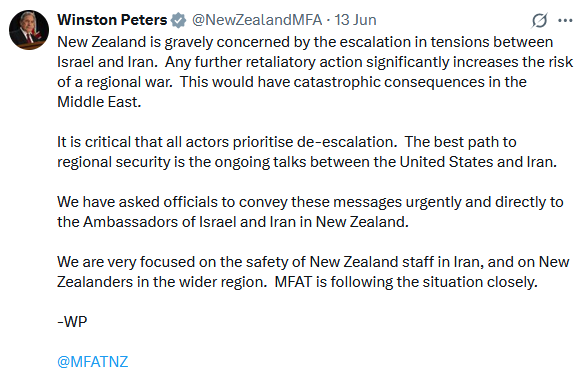
Fresh from refusing to condemn Israel for its egregious war crimes of industrial-scale killing and mass starvation of civilians in Gaza, our Foreign Minister has outdone himself with the most craven of tweets on Israel’s massive attack on Iran.


Winston Peters has said he is “gravely concerned by the escalation in tensions between Israel and Iran” and that “all actors” must “prioritise de-escalation”.


There is no mention of Israel as the aggressor and no condemnation of Israel’s attack launched in the middle of negotiations between Iran and the US on Iran’s nuclear programme.


“It’s Mr Peters’ most obsequious tweet yet which leaves a cloud of shame hanging over the country” 

“Appeasement of this rogue state, as our government and other western countries have done over 20 months, have led Israel to believe it can attack any country it likes with absolute impunity”


“Israel has conducted mass killing and mass starvation of Palestinians and then attacked any country which has objected to its barbarity – namely Yemen, Lebanon, Syria and now Iran”

Mr Peters’ tweet continues the government’s fact-free and principle free line that Israel has the right to defend (by attacking other countries) but Iran does not”


“Holding Israel to account based on international law and United Nations resolutions is the magic solution to end forever the ongoing crises in the Middle East”


Maher Nazzal

Co-Chair PSNA

Weather News – A frosty start to the week, but rain is on the horizon – MetService

Source: MetService

Covering period of Monday 16th – Thursday 19th June – A frosty start to the week, but rain is on the horizon.

• Cold, clear nights bring widespread frosts for much of the country
• Sunny days for most, foggy mornings for some
• Showers linger in the north before clearing
• Wet weather returns from the west on Thursday

A stretch of settled winter weather kicks off the week for much of Aotearoa New Zealand, with widespread frosts expected for areas south of the central North Island. Crisp clear days, chilly nights and some foggy mornings will be the dominant theme.

Christchurch is expected to reach lows of -3°C this week, Dunedin not much warmer at -2°C. Further north, Wellington could dip as low as 3°C, while Hamilton starts Wednesday at 1°C. Even Auckland is in for a brisk start, with temperatures forecast to drop to 6°C.

“People will really feel those frosty starts, particularly inland where we’re expecting consistent cold temperatures,” says MetService meteorologist Devlin Lynden.
“With clear skies great for early Matariki viewing, much of the South Island is dipping well into the negatives in the mornings, lovely winter temperatures.”

Daytime conditions will be mostly sunny. However, not all areas will be cloud-free. Patchy cloud and the odd shower linger around Northland and the eastern North and South Islands early in the week, as a light southeasterly flow carries moisture into those regions.

Parts of the South Island can expect persistent fog and low cloud to form under these settled conditions, especially in valleys. “Towns like Wanaka, Queenstown, and Alexandra, and those in the Mackenzie Basin may feel a bit grey and gloomy, unless you escape up to the ski fields where the sun will be out in full force” says Lynden.

From midweek, a more active weather pattern moves in from the Tasman Sea. Rain is forecast to reach the West Coast of the South Island late Wednesday, before spreading into the western North Island through Thursday.

“After several days of calm, and mostly dry weather, that midweek shift will bring a noticeable change, especially in the west, where rain is likely to set in,” adds Lynden. “There’s potential for heavier falls and stronger winds in some areas on Thursday”

Stay up to date at metservice.com, and check back this Wednesday for the Matariki long weekend outlook.

Health and Employment Advisory: Senior medical and dental officers 24-hour strike in Te Tai Tokerau

Source: Association of Salaried Medical Specialists

Senior medical and dental officers who are members of the Association of Salaried Medical Specialists – Toi Mata Hauora (ASMS) and are employed in the Te Tai Tokerau district of Health New Zealand will be on strike for 24 hours from 10.00am Wednesday 18 June until 10.00am Thursday 19 June.
During that time and as required ASMS members will ensure life preserving services are maintained across the region’s four hospital sites in Whangarei, Dargaville, Kaitaia and Bay of Islands.
ASMS has 240 members in the Te Tai Tokerau district.
Members voted 83 per cent in favour of the strike.
On Tuesday 17 June at 6pm in the Calfer Suite of Forum North in Whangārei ASMS and the New Zealand Nurses Organisation are hosting a public meeting “Your Health System in Crisis” to give members of the public a chance to hear from doctors and nurses about what is really happening in their hospital.
At 10am on Wednesday 18 June ASMS members will stage a mass walk out from Whangārei Hospital and picket on the corner of Maunu and Hospital Rds. There will also be a picket outside Kaitaia Hospital on Redan Rd. Both pickets will run for forty-five minutes.
This district strike is part of an ongoing industrial dispute.
The collective employment agreement between ASMS and Health New Zealand expired in August 2024. Health New Zealand’s pay offer is well below CPI . The parties are still far apart and are currently in facilitated bargaining. Facilitated bargaining is a confidential process.
On 1 May ASMS members undertook a 24-hour nationwide strike. And on 28 May ASMS members in Tairāwhiti held a 24-hour district strike. 

Peace Action Wellington – Israel’s pre-emptive war illegal, unjustified

Source: Peace Action Wellington

14 June 2025 – Israel’s unprovoked and extensive bombing of Iran yesterday is illegal under international law. There is no allowable claim of self-defence for a pre-emptive attack; such a claim would validate Russia’s aggression in Ukraine, and the US’s attack on Iraq in 2003. 

“The New Zealand Government needs to be unequivocal in its condemnation of Israel now,” said Valerie Morse, member of Peace Action Wellington.

“The bombing of Iran has no justification. The Israeli state appears to consider itself beyond reproach in its conduct: in the past six months, it has bombed Lebanon, Syria, Yemen and Iran all while it conducts the most vile genocide against Palestinians in Gaza and daily attacks against civilians in the occupied West Bank.” 

“No one believes Israel’s lies anymore. Time after time, Israel’s claims have been shown to be completely fabricated. We didn’t buy US President George W. Bush’s claims about Iraq having ‘weapons of mass destruction’ in 2003 that precipitated the US invasion and murder of 1 million Iraqi people; and we are not about to buy Netanyahu’s claims about an ‘existential threat’ now. ”

“No one is buying Israel’s false victimhood either: it possesses nuclear weapons and continues to be the largest recipient of US aid and weapons. Netanyahu has spent all of Israel’s political capital with his craven determination to remain in power. The international consensus that has funded and facilitated the ongoing occupation of Palestinian lands is crumbling. Now he is trying to drag the entire world into war. He will be the last Israeli prime minister because he will destroy the Israeli state with his self-serving violence and war-making.”

“Aggressive war cannot be tolerated. Genocide cannot be tolerated. New Zealanders want our government to take concrete actions: expel the Israeli Ambassador, sanction the Israeli state and recognise Palestine.”

Economy – Monetary policy affects some parts of the economy differently: RBNZ Analytical Note

Source: Reserve Bank of New Zealand

16 June 2025 – Some parts of the economy and prices for some products are more sensitive to a rise in the Official Cash Rate (OCR) than others.

Reserve Bank of New Zealand – Te Pūtea Matua research found that sectors that make or trade goods, as well as housing and real estate related sectors are among the most sensitive to changes in the Official Cash Rate.

“When the OCR increases, these sectors tend to cool more quickly. On the other hand, sectors like primary production including dairy and meat, are less sensitive,” the Analytical Note authors say.  

The research also looked at how monetary policy affects prices across a wide range of domestic goods and services, which do not face as much foreign competition as internationally traded goods.

“We found that prices for accommodation are quite sensitive. So, when the OCR increases, it puts downward pressure on the cost of going on holiday or business,” the authors say.  

An OCR increase also has a strong impact on the cost of building a home. This means when the OCR increases, there is relatively more downward pressure on these costs than for prices of other domestic goods and services in the economy. Some services, like household power prices and insurance, are slower to respond to increases in the OCR.

We carried out this research because identifying which parts of the economy are relatively more sensitive to monetary policy allows us to better understand how various parts of the economy may react when interest rates change. It also means we can see more clearly if past policy decisions are working through to the economy as expected.

More information:

Read the Analytical Note
A research paper by Magnus Astebol and Nimesh Patel: https://govt.us20.list-manage.com/track/click?u=bd316aa7ee4f5679c56377819&id=30c1814904&e=f3c68946f8

Watch a short video: https://govt.us20.list-manage.com/track/click?u=bd316aa7ee4f5679c56377819&id=f4070f8fec&e=f3c68946f8

Other Analytical Notes: https://govt.us20.list-manage.com/track/click?u=bd316aa7ee4f5679c56377819&id=8a021ec357&e=f3c68946f8

Key findings:

We investigate the sensitivity of output and prices to monetary policy at a disaggregated level, focusing on GDP sectors and CPI non-tradables subgroups in New Zealand. Identifying which parts of the economy are relatively more responsive to monetary policy allows us to better understand how various parts of the economy may evolve in response to policy decisions and to better assess whether past policy decisions are transmitting to the economy as expected.  
For GDP, we find that goods-producing and goods-trading sectors are the most sensitive to monetary policy, while primary production and public services are the least sensitive.
For CPI non-tradables inflation, we find subgroups such as housing construction costs and accommodation services are more sensitive to monetary policy, while subgroups such as energy and insurance are less sensitive.
The small sample size leads to greater variation in estimated effects across model variations. As such, this analysis aims to serve as a starting point for further work in this area.