
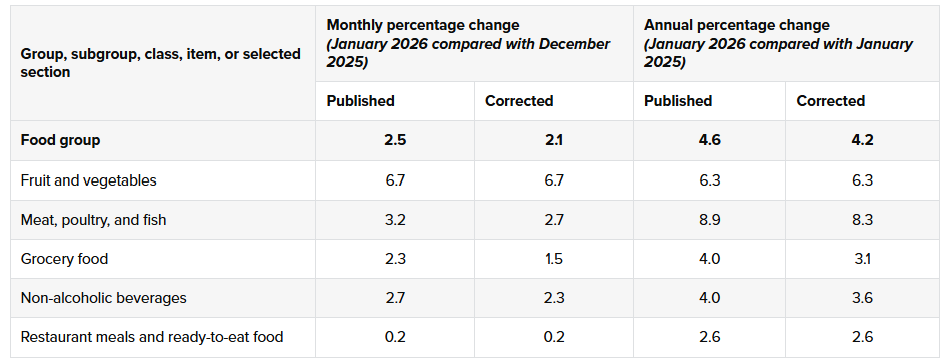
Annual food prices increase 4.5 percent – Stats NZ news story and information release

Error notification: Food price index (FPI) for January 2026 – Stats NZ news story

From Gloriavale to KiwiSaver: human rights abuses in plain sight – Mindful Money

Source: Mindful Money, Barry Coates

KiwiSaver investors increasingly exposed to companies linked to human rights abuses

New analysis shows KiwiSaver investments in companies linked to human rights concerns have surged, despite human rights violations remaining the top ethical priority for New Zealand investors.

KiwiSaver investments in companies identified as contributing to human rights harms have increased sharply. Over the past six months alone, investments in these companies rose 43 percent, reaching more than $3.5 billion. This has been fuelled by both an increase in the number of companies identified as violating human rights, as well as increased investment in those companies.

Yet public surveys conducted over the past six years consistently show that avoiding human rights abuses is the number one concern for KiwiSaver members in New Zealand when deciding where their retirement savings should be invested.

“These findings highlight a growing gap between what New Zealanders want from their investments in terms of human rights, and where their money is actually going,” said Barry Coates, founder of Mindful Money.

“New Zealanders consistently say they do not want their retirement savings linked to labour exploitation, abuses of children, gender discrimination, harm to vulnerable communities or companies contributing to conflict. Yet billions of dollars are still invested in companies connected to these risks.”

There is also increasing public awareness of the human impact of labour exploitation within New Zealand. A new podcast from Mindful Money interviews Pearl Valor, who speaks about her labour experiences growing up in the Gloriavale Christian Community.  Together with Brian Henry, Barrister for Pearl Valor and Founder of Always-Ethical – AE KiwiSaver Plan.

“People need to understand that exploitation can be hidden in plain sight,” says Valor. “When communities or companies operate without accountability, the people inside them can lose their freedom, their wages and their voice.”

Greater awareness is the first step toward protecting human rights. The Modern Slavery Bill introduced to New Zealand Parliament in February 2026 marks significant progress towards more ethical supply chains, and addressing the issues of slave and forced labour in Aotearoa.

Coates says investors have a powerful role to play.

“KiwiSaver providers need stronger policies to screen out companies linked to serious human rights harms. New Zealanders deserve confidence that their retirement savings are not contributing to exploitation or conflict.”

Human rights concerns increasingly relate to harmful corporate practices rather than harmful products themselves. While fund providers screen out issues like tobacco and gambling, few have active screens to avoid investing in harmful behaviour like human rights violations.

“My aspiration is that current members of Gloriavale, now equipped with access to news and the internet, will be empowered to acquire financial literacy and independence, and become aware of beneficial resources such as KiwiSaver.” Says Pearl” says Pearl

“I will always be grateful to Brian for his commitment to justice for those leaving the Gloriavale Community. Through this work, I and many others have been able to step into a freer world that we were never allowed to see. Modern-day slavery is real and it exists in New Zealand today. Brian is helping expose this injustice and is standing up for those who were denied their freedom, their wages, and their voice.” Says Pearl

In recent years, attention has increasingly focused on the activities of major technology companies, particularly around surveillance, social media harms and their use in conflict situations. Companies identified as raising human rights concerns include Meta, Tesla, Thermo Fisher Scientific and Palantir Technologies.

Concerns have also grown over investments in companies linked to the ongoing conflict in Gaza, the West Bank and Ukraine.

Despite concerns from members of the public, KiwiSaver investments in companies providing weapons, surveillance technology or other support linked to these conflicts increased 14 percent between March and September 2025, reaching $856 million.

Companies receiving increased investment during this period include IBM, Booking Holdings, Palantir Technologies, Motorola Solutions and Caterpillar.

“Where money flows, systems follow. Ethical investment redirects capital away from modern slavery and toward dignity, transparency, and fair work.” says Brian

“These are major global corporations, and New Zealand investors have only a small share of their capital,” Coates said. “It is unlikely that fund managers sending letters or voting a few shares will change their practices. If companies are linked to human rights violations, fund providers should respect the wishes of their clients and avoid investing in them.”

Mindful Money identifies companies associated with human rights concerns on its website, including those linked to Palestinian human rights issues, which are marked with an OPT symbol so KiwiSaver members can see whether their funds are invested in them.

Mindful Money is calling on KiwiSaver providers to strengthen their human rights screening and divest from companies associated with human rights violations.

People power

Members of the public can easily see what their fund is investing in by going to the Mindful Money website www.mindfulmoney.nz. Mindful Money is a charity and provides transparency to KiwiSaver and retail funds investors.

“All investment decisions for the AE KiwiSaver Plan are undertaken in-house, reflecting Brian Henry’s ethical management approach and his ongoing commitment to justice, which is currently demonstrated through his involvement in the Gloriavale case.” says Sandra Clark (CEO)

Members of the public can check what is in their fund using the free Fund Checker.

Notes:

Mindful Money publishes the methodology for companies that have a record of breaching internationally-agreed human rights norms. Methodology here.

https://mindfulmoney.nz/learn/how-does-mindful-money-identify-companies-who-have-breached-human-rights/

Human rights violations are shown in the categories of breaches of labour rights; war and conflict; corruption and breaches of business ethics; public health and safety; and other violations including privacy and indigenous peoples’ rights.

Link to YouTube Gloriavale interview
https://youtu.be/b12McipxAZA?si=7tVIaqY2lBfOaqcL

Three Kiwi Students Set to Honour ANZAC Legacy in Türkiye – AFS Gallipoli Youth Awards 2026

Source: AFS Intercultural Programmes New Zealand

Three exceptional New Zealand students are preparing for a journey of remembrance and discovery as they depart next month for the Gallipoli Peninsula. Awarded the AFS Gallipoli Youth Award 2026, Tim Kirke (Timaru),Takikawa Rangi (Te Puia Springs), and Lexie Knight (Tauranga) will travel to Türkiye from 7- 27 April to connect with their family histories and attend ANZAC Day commemorations.
The AFS Gallipoli Youth Award is a prestigious scholarship that selects recipients based on their dedicated research into their ancestors' roles in World War I. This year’s winners each bringing a deeply personal story to the three-week exchange programme:
Tim Kirke (Timaru): Recognised for his outstanding presentation on his Great GreatGrandfather, Charles Sealy Verity, and how Verity's legacy continues to influence Tim’s life today.
Takikawa Rangi (Te Puia Springs): Takikawa researched his Great Uncle Rere Hauiti of the First Māori Contingent, highlighting the sacrifices made to secure a better future for coming generations.
Lexie Knight (Tauranga): Lexie used family letters to create a moving account of her threeGreat Great Uncles – Herbert, George, and Douglas Knight – two of whom were involved in the Gallipoli campaign.
During their time in Türkiye, the students will be hosted by local Turkish families and participate in cultural activities. The programme is facilitated by AFS New Zealand and AFS Türkiye and is supported in part by the New Zealand Embassy to Türkiye.
The AFS Gallipoli Youth Awards 2026 are generously funded by the AFS Educational Trust and the Michael Jull Memorial Trust.
“This award embodies our core mission of creating a more just and peaceful world through understanding; a mission more relevant today than ever,” says Shirley Webb-Speight, National Director of AFS Intercultural Programmes New Zealand.
Originally founded in 1914 as a volunteer ambulance corps (the American Field Service), AFS has been sending New Zealand students abroad to foster global peace since 1947.
Media are invited to contact us for opportunities to follow the students' journeys as they bridge the gap between New Zealand’s past and a global future.
About AFS: AFS Intercultural Programmes is an international, voluntary, non-governmental, non-profit organisation that provides intercultural learning opportunities to help people develop the knowledge, skills and understanding needed to create a more just and peaceful world.

Health – Alcohol reforms risk taking Aotearoa backwards on harm prevention

Source: Hapai Te Hauora

Hāpai Te Hauora says proposed reforms to alcohol laws risk taking Aotearoa backwards in efforts to reduce alcohol-related harm.
The Government has announced changes aimed at reducing regulatory barriers and making it easier for businesses to obtain alcohol licences. Ministers say the reforms reflect a belief that adults should be trusted to make their own choices in a free society.
But Hāpai Te Hauora Chief Operating Officer Jason Alexander says alcohol harm cannot be understood as simply a matter of individual responsibility.
These proposed changes undermine recent progress made through the Sale and Supply of Alcohol (Community Participation) Amendment Act 2023, which strengthened community voice in licensing decisions and supported the development and implementation of Local Alcohol Policies. Introducing reforms that move in a different direction raises questions about what priorities are now guiding New Zealand’s alcohol policy.
“Alcohol harm doesn’t happen in isolation. It is shaped by the environments we create – how widely alcohol is available, how it’s marketed, and how many outlets operate in a community,” Alexander said.
Alexander says decades of public health evidence show that policy settings play a major role in influencing alcohol harm, and that weakening existing safeguards risks undoing progress made to reduce harm.
One of the most significant proposed changes would restrict who can object to alcohol licence applications. Alexander says limiting objections to those within a Territorial Authority boundary risk excluding communities who may still be directly affected.
Territorial Authority boundaries do not always reflect the realities of communities, he said, noting that people may live just outside a boundary but still be physically close to a proposed outlet and experience the impacts. Hapū and iwi boundaries can also overlap multiple Territorial Authorities, raising questions about how those interests will be recognised if community voice is restricted.
Alexander also raised concerns about proposals that could expand the settings in which alcohol can be served.
Expanding the setting for the sale and supply of alcohol – from retail environments to personal services – risks further embedding alcohol into everyday life. Greater visibility, availability and normalisation are key drivers of alcohol harm, which is why strong regulation of licensing and marketing is essential.
Hāpai Te Hauora says any changes to alcohol regulation should strengthen, rather than weaken, public health protections and the ability for communities to have a say on harmful products in their community.
“If we want safer communities and healthier whānau, alcohol policy must continue to prioritise prevention,” Alexander said.
These proposed changes come at a time when the Government is placing significant emphasis on economic growth. While economic wellbeing matters, it must not come at the cost of public health. Weakening safeguards around alcohol will increase exposure to harm and place even greater pressure on whānau, communities, and an already stretched health system.
Alcohol harm is already estimated to cost Aotearoa New Zealand $9.1 billion every year through preventable illness, injury, lost productivity, and wider social harm. Any reform to alcohol policy must put health, wellbeing, and equity at the centre. 

ChildFund – Any war is a war on water

Source: ChildFund New Zealand

When oil prices surge, most people think about petrol. Few think about water.
The volatility in oil prices since the war in the Middle East does not stop at fuel pumps. It flows through to transport, infrastructure and essential services, especially in some of the poorest countries.
“Water systems run on energy. When oil prices spike, the cost of pumping, treating and delivering water rises too. In vulnerable communities, there is no financial cushion to absorb that shock,” says ChildFund New Zealand CEO Josie Pagani.
In many of the communities where ChildFund works, in the Pacific and beyond, clean water depends on bore pumps powered by diesel or electricity priced against global fuel markets. A surge in oil price increases operating costs immediately. Spare parts become more expensive. Transport costs rise. Maintenance is delayed.
“A rise in oil prices in one part of the world can mean a village pump runs fewer hours a day somewhere else.”
The consequences fall hardest on children.
When water systems become unreliable, families are forced to rely on unsafe sources. Waterborne diseases spread more easily. Girls are often pulled from school to collect water. Household income is diverted to cope with illness or to buy water from private suppliers.
“Access to clean water changes everything for a child. It means health instead of sickness. School instead of long walks carrying heavy containers full of water.”
Conflict also damages water infrastructure directly. Pipes, wells and treatment plants are frequently destroyed in war zones. But even communities far from conflict feel the economic aftershocks through global energy markets.
“Any war is a war on water. Children living thousands of kilometres from a battlefield still feel the impact when global shocks make essential services more fragile.”
ChildFund invests in long-term water resilience, including gravity-fed systems and solar pumping designed to reduce dependence on volatile fuel markets. Strengthening community-managed systems helps protect children from global economic shocks.
“Children already pay the biggest price in war. Access to clean water should not be part of that,” says Josie Pagani.

Health – Additional winter health care workers a drop in the ocean of need – NZNO

Source: New Zealand Nurses Organisation

The Government’s announcement today of 378 extra staff to help hospitals cope with winter demand is a drop in the ocean of what patients need, NZNO says.
Tōpūtanga Tapuhi Kaitiaki o Aotearoa NZNO Chief Executive Paul Goulter says every extra staff member is helpful.
“However, our hospitals are in crisis and barely keeping up with demand before the winter respiratory illnesses hit.
“The capacity for hospitals to meet patient need has been severely depleted after two years of Government cost-cutting and funding to an arbitrary budget.
“We constantly hear from our members that Te Whatu Ora regional health directors are deliberately delaying recruitment and still not giving local managers approval to fill vacancies,” Paul Goulter says.
“These additional staff are a drop in the ocean of what patients need. The 378 full-time equivalent (FTE) staff include medical, nursing, health care assistants, allied health, support and non-clinical roles, but it is unclear how many of those are nurses.
“These additional nurses aren’t going to go far considering an Infometrics report released last year found our hospitals were short on average 587 nurses every shift,” he says.
“The same report (page 22) found that nursing staff shortages are three times as bad in winter. It found between 2022-2024 nursing staffing were about 50,000 FTE hours short in April compared to 150,000 FTE hours short in July.
Paul Goulter says additional short stay beds in the hospitals and for aged residential care are desperately needed.
“NZNO acknowledges the acute need at Middlemore, Waikato, Wellington and Christchurch hospitals. But unfortunately, other hospitals are at capacity even before the winter illness peak,” he says.  

Northland News – Taitokerau can lead rural climate resilience; study

Source: Northland Regional Council

A comprehensive local study has found Taitokerau could lead the way in rural climate resilience by building on what is already working, aligning support across agencies and investing in practical, region-specific solutions.
The Climate Resilient Communities Project was initiated by Rural Support Trust Te Tai Tokerau (RSTTT) with a $40,000 grant from the Northland Regional Council Climate Resilient Communities Fund.
The project involved a region-wide survey of 200 respondents, two Māori wananga, 10 workshops, 61 follow up interviews and a sector leadership hui and resulted in a more than 50-page report “Understanding climate impacts and adaptation in rural communities”.
Regional councillor and farmer Geoff Crawford says it found that Northland’s rural communities are already living with the realities of a changing climate with more intense rain events, longer dry spells and shifting seasons testing the resilience of its land, infrastructure and people.
“The report shows extreme weather is already disrupting operations, but most farmers are adapting.” “Confidence is mixed and financial and regulatory pressures remain significant.”
Councillor Crawford says regulation and cost pressures are the most consistently raised barriers, limiting capacity for long term planning.
“Practical adaptation is widespread and largely self-driven, solar, feed planning, diversification, planting and water storage.”
He says wellbeing and community connection are critical resilience factors with high value placed on support from RSTTT, local networks and informal events.
“Peer learning is a major driver of change with farmers wanting to see working examples, hear real stories and learn locally.”
Looking ahead, the report’s authors recommend strengthening locally-led, practical efforts.
“Farmers and growers want hands-on, regionally relevant examples rather than generic advice.”
They also recommend prioritising water resilience.
“Drainage, storage, effluent systems and catchment protection emerged as the strongest shared needs across all data sources.”
The report suggests development of a Northland Water Resilience Programme to expand water storage support, strengthen catchment collaboration and target technical assistance to high-risk landscapes.
It also recommends supporting energy reliability and transition.
“Power outages present operational risks for all sectors, especially dairy and horticulture.”
In the future, it suggests providing independent solar and battery feasibility advice, and exploring cluster or community-scale renewable solutions for remote rural areas.
The study notes regulation and administration load are major barriers to planning for resilience and suggests creation of a Climate Resilience Helpdesk or digital hub offering plain language guidance on rules, templates for compliance tasks and clear links to NRC, RSTTT, Kaipara Moana Remediation and industry support.
It recommends recognising and investing in community wellbeing as core resilience infrastructure and expanding region-specific science and technical expertise.
“Farmers and growers want more applied research and specialist visits tailored to Northland’s climate, soils and crops.
It suggests the establishment of a Northland Resilience Science Hub with NRC, industry partners, NorthTec and researchers to run local trials and provide technical advice on soils, pasture resilience, crop diversification and biodiversity.
In summary, the report concludes by building on what is already working, aligning support across agencies and investing in practical, region-specific solutions “Taitokerau can lead the way in rural climate resilience.”
“This report provides a foundation for that next chapter – turning local insight into coordinated action that strengthens communities, supports whenua and prepares Northland’s rural sector for the challenges and opportunities ahead.”  

Environment – Have your say on three internationally restricted chemicals – EPA

Source: Environmental Protection Authority

The Environmental Protection Authority (EPA) is calling for submissions on plans to restrict three Persistent Organic Pollutants (POPs) recently added to the Stockholm Convention on Persistent Organic Pollutants.  
Aotearoa New Zealand has signed this international environmental agreement, so must stop or limit producing, using, importing, and exporting POPs listed under the Stockholm Convention.
The EPA is proposing to restrict the following three chemicals – and products containing them – by either banning or limiting their use:
  • Chlorpyrifos is an organophosphate pesticide used as a broad-spectrum insecticide in a range of agricultural crops and for biosecurity purposes. The EPA has recently completed a reassessment of this substance.
  • MCCPs are widely used as plasticisers in PVC, additives in metalworking fluids, and in paints, sealants, and adhesives.
  • LC-PFCAs are a group of long-chain per- and polyfluoroalkyl substances (PFAS), used in a range of applications including in medical and laboratory devices, photo-imaging, food contact materials, paints and surface coatings, fire-fighting foams, textiles and apparel, personal care products, and cleaning agents.
Dr Peter Dawson, Principal Scientist Hazardous Substances, says these POPs are harmful chemicals that do not easily break down and can be transported long distances in the environment. They can build up in people, animals, and the environment over time, and some have been linked to serious health effects.
“Restricting the use of these substances is the right thing to do, it will protect people and the environment by reducing exposure to these harmful chemicals.
“It also ensures New Zealand fulfils our important obligations under the Stockholm Convention.
“The purpose of publicly consulting on the proposed restrictions for these chemicals is to better understand how these changes will impact New Zealand. Feedback will help us determine which exemptions are essential while ensuring we continue protecting people and the environment.”
The listings of the three persistent organic pollutants under the Stockholm Convention take effect on 16 December 2026.
The public consultation runs from 17 March – 17 April 2026.  

EMA – Employers call for regulation of employment advocates as dispute resolution system falters

Source: EMA

The Employers and Manufacturers Association (EMA) is calling for a review of the employment disputes resolution system and especially the conduct and regulation of employment advocates, following a survey of more than 300 of its members.
Employers pointed to an escalating number of disputes, rising costs, longer case durations, and increasingly adversarial behaviour by employment advocates as growing issues within the system.
EMA Head of Advocacy and Strategy Alan McDonald says the findings show a system “under increasing strain”.
“Employers are telling us the process has become overly complex and burdensome,” he says.
“Disputes are taking longer to resolve and costing far more than they used to. Even when businesses do everything right, many feel pressured to settle early because the cost of defending a claim can be higher than the actual claim.”
Unregulated employment advocates labelled ‘ambulance chasers’
Respondents highlighted the growing influence of unregulated advocates, particularly those operating on ‘no-win, no-fee’ models, citing aggressive or unprofessional behaviour, process delays, inflated settlement demands, high fees for low-quality work, and advice that fuels unnecessary escalation.
“We heard employers describe some advocates as ‘cowboys’ or ‘ambulance chasers’ – strong language that reflects genuine frustration,” says McDonald.
“The common theme is a lack of professional standards. Anyone can call themselves an employment advocate, charge whatever they like, and face no consequences for unethical behaviour.”
Employers also reported that advocates’ fees increasingly become the driving factor in settlement negotiations, with some representatives pushing for their own costs to be covered before meaningfully representing the employee’s interests.
The emergence of AI-generated correspondence – described by some employers as lengthy, inaccurate, or contextually misleading – is also contributing to delays and rising expectations.
The survey drew more than 150 responses in the first few hours and 316 responses overall, indicating strong concern among employers about how the system is operating in practice.
“The speed and volume of the responses show we really hit a raw nerve for employers,” says McDonald.
The EMA is sharing the findings with MBIE, and joining a number of organisations urging the government to review the disputes mediation process and introduce appropriate regulation of employment advocates.
“We want to see accountability for advocates. Employees deserve competent, ethical support, and employers deserve a fair, efficient system they can have confidence in. This shouldn’t be the Wild West,” says McDonald.
The EMA is calling for clear standards that would help protect both employees and employers, reduce unnecessary escalation, and restore trust in a system that many believe is no longer working as intended.
“This survey shows the pressure points clearly. If we don’t act now, the costs, delays and adversarial behaviour will only get worse,” says McDonald. “Regulation of employment advocates is the logical place to start.”